

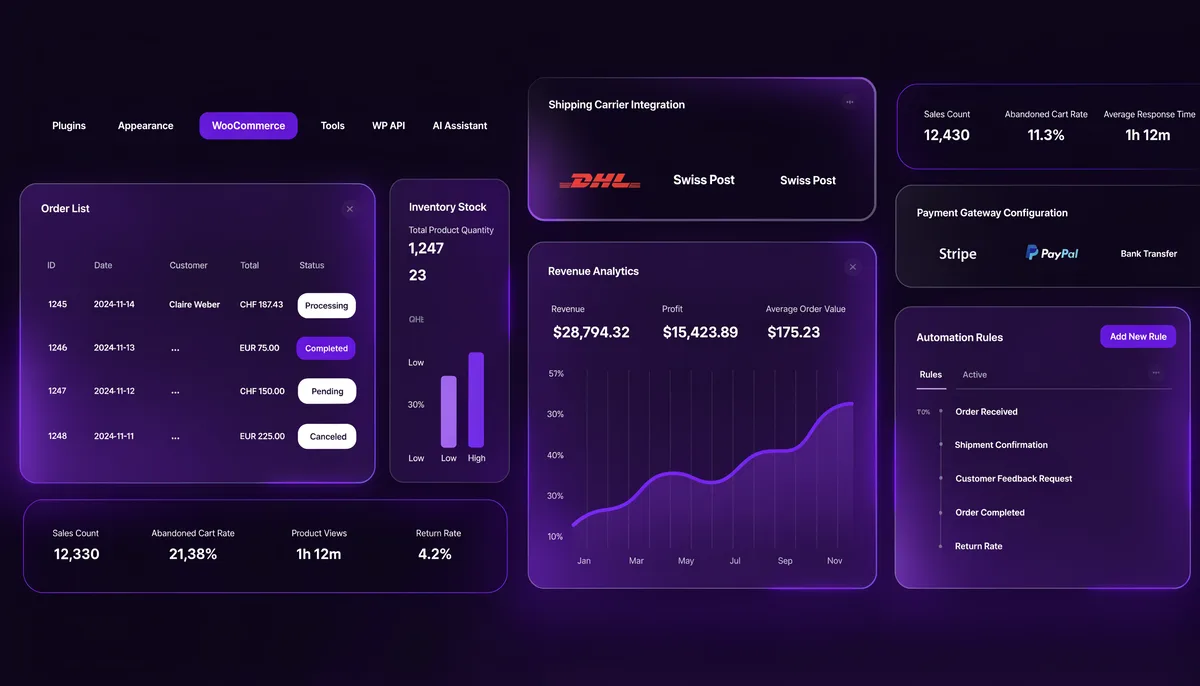
WooCommerce vs SureCart 2026 compared side by side. Discover which WordPress e-commerce plugin fits your store, budget, and growth goals best.
Choosing the right e-commerce plugin for your WordPress site in 2026 is more consequential than ever. With online competition intensifying across every niche, your platform's performance, flexibility, and total cost of ownership can make or break your store. Two names dominate the conversation right now: WooCommerce — the long-reigning heavyweight — and SureCart, the modern challenger that has been quietly winning over merchants who are tired of plugin bloat and maintenance headaches.
This guide breaks down both platforms across every dimension that matters: setup complexity, feature depth, pricing, performance, scalability, and support. By the end, you will know exactly which solution fits your business model and growth roadmap in 2026.
What Is WooCommerce?
WooCommerce is an open-source e-commerce plugin built on WordPress. Originally developed by WooThemes and acquired by Automattic in 2015, it powers an estimated 28% of all online stores worldwide, according to BuiltWith trend data. It transforms any WordPress site into a fully functional store, handling products, payments, shipping, taxes, and customer management through a vast ecosystem of extensions.
Its greatest strength is flexibility: because it is open source and deeply integrated with WordPress, developers can customize virtually every aspect of a WooCommerce store. However, that flexibility comes at a price — namely, complexity, ongoing maintenance, and a plugin stack that can slow your site to a crawl if not carefully managed.
WooCommerce Strengths
- Massive ecosystem with thousands of free and premium extensions
- Deep WordPress integration — works with any theme or page builder
- Full control over hosting, data, and customization
- Large developer community and extensive documentation
- Supports physical products, digital downloads, subscriptions, and bookings
WooCommerce Weaknesses
- Requires significant plugin stacking for advanced features (payment gateways, subscriptions, memberships)
- Performance degrades without a solid managed WordPress host like Cloudways
- Core features like subscriptions and recurring billing cost extra
- Higher ongoing maintenance burden — updates, security patches, compatibility checks
- Steeper learning curve for non-technical store owners
What Is SureCart?
SureCart is a next-generation e-commerce plugin that takes a fundamentally different architectural approach. Instead of processing everything on your WordPress server, SureCart offloads the heavy lifting — payment processing, subscription management, order data — to its own infrastructure. Your WordPress site handles the front end and content; SureCart handles the commerce logic in the cloud.
This hybrid architecture means dramatically lower server load, faster checkout experiences, and far fewer plugin conflicts. SureCart has built-in support for one-time payments, subscriptions, payment plans, digital products, and even membership access controls — all without purchasing additional add-ons. It integrates natively with Stripe, PayPal, and several regional payment providers, and its affiliate link at SureCart offers a generous free tier that lets small stores get started at zero cost.
SureCart Strengths
- Cloud-based order processing reduces server load significantly
- Subscriptions, payment plans, and digital products included in the core plugin — no paid add-ons required
- Cleaner, faster checkout flow out of the box
- Integrated affiliate management and coupon system
- Pairs perfectly with SureMembers for gated content and membership sites
- Dramatically lower total cost of ownership for small to mid-sized stores
SureCart Weaknesses
- Smaller ecosystem compared to WooCommerce — fewer third-party integrations
- Physical product and complex shipping scenarios are less mature
- Less suitable for very large catalogs with thousands of SKUs and complex inventory management
- Dependent on SureCart's cloud infrastructure — less control over data pipeline
WooCommerce vs SureCart: Feature-by-Feature Comparison
Setup and Ease of Use
WooCommerce setup is straightforward on the surface — install, run the wizard, configure shipping zones, connect a payment gateway. But as your store grows and you layer in extensions for subscriptions, memberships, or abandoned cart recovery, the configuration burden multiplies quickly. SureCart, by contrast, is designed to be operational in under 30 minutes. Its onboarding wizard is genuinely intuitive, and because core commerce features are bundled, you rarely need to install additional plugins.
Pricing and Total Cost of Ownership
WooCommerce itself is free, but the real-world cost accumulates fast. A typical mid-tier WooCommerce store running subscriptions, a premium payment gateway extension, a membership plugin, and a dedicated managed host like LiquidWeb can easily exceed €150–€250 per month before marketing costs. SureCart's pricing is transaction-fee-based on lower plans and moves to flat monthly pricing at higher tiers — a model that is often significantly cheaper for stores with predictable order volumes. Check SureCart's current pricing before you plan your budget.
Performance
Performance is where SureCart's architectural advantage becomes most visible. Because order processing, payment handling, and subscription logic live on SureCart's servers rather than yours, your WordPress server is under far less strain at checkout. WooCommerce stores, particularly those running multiple extensions, often require aggressive caching strategies, a powerful hosting plan, and a CDN to maintain fast load times. SureCart stores on even modest hosting plans tend to achieve strong Core Web Vitals scores with minimal optimization work.
Scalability
For enterprise-scale stores with complex inventory, custom workflows, and thousands of concurrent users, WooCommerce — especially on dedicated managed infrastructure — remains the more proven path. Its open-source nature means your development team can extend and optimize it to exact requirements. SureCart scales well for the vast majority of small and mid-market stores, but large-catalog physical retail scenarios are still better served by WooCommerce or a purpose-built platform like Shopify.
Membership and Digital Products
This is a clear win for SureCart in most scenarios. Building a membership site or selling digital products on WooCommerce typically requires stacking several paid plugins — WooCommerce Subscriptions, a membership plugin like MemberPress, and a digital delivery extension. SureCart handles digital product delivery, payment plans, and subscription billing natively, and when combined with SureMembers, it creates one of the most streamlined membership commerce stacks available on WordPress today.
Which Should You Choose in 2026?
The answer depends heavily on your store type and technical resources. Here is a practical decision framework:
- Choose WooCommerce if you sell complex physical products with custom shipping rules, need deep ERP or POS integrations, or have a development team that can manage the ecosystem.
- Choose SureCart if you sell digital products, online courses, memberships, or subscriptions — especially if you want low maintenance overhead and a faster time-to-revenue.
- Choose SureCart if you are a solopreneur or small team without a dedicated WordPress developer on staff.
- Choose WooCommerce if your business relies on a highly specific extension that has no SureCart equivalent.
- For most new stores launching in 2026, SureCart offers a significantly better starting point — you can always migrate to a more complex stack later if your needs evolve.
Migration and Switching Costs
One factor many merchants overlook is the cost of switching later. Migrating from WooCommerce to SureCart — or vice versa — involves exporting customer data, reconnecting payment methods, rebuilding product pages, and retraining your team. Our WooCommerce and SureCart migration service helps businesses make this transition cleanly, minimizing downtime and data loss. If you are already running WooCommerce and considering a move to SureCart, a professional migration is strongly recommended rather than attempting a DIY approach.
Final Verdict
In 2026, there is no single universal winner between WooCommerce and SureCart — but the gap in use cases is clearer than ever. WooCommerce remains the gold standard for complex, large-scale physical retail operations where maximum extensibility is non-negotiable. SureCart has emerged as the smarter default for digital-first businesses, membership platforms, course creators, and anyone who values a leaner, faster, lower-maintenance e-commerce stack.
If you are starting fresh or planning a redesign this year, we strongly recommend evaluating SureCart before defaulting to WooCommerce out of habit. The platform has matured significantly and its total cost of ownership advantage is hard to ignore. For a deeper dive into your specific requirements, our team at NEXITO MEDIA offers a free discovery call to map the right stack to your business goals.
Not Sure Which Platform Is Right for You?
Our e-commerce specialists compare your requirements against both platforms and deliver a clear recommendation — plus a migration plan if you are ready to switch.
Get a Free Platform Assessment